Plug-in solar kits became legal to buy and use in England, Wales and Scotland on 27 August 2026. They're cheap, simple and genuinely useful, but they're not the same as a roof system, and not every kit on sale is compliant. Here's the plain-English version.
A plug-in kit won't power your house, and it won't earn you export income. What it does well is take a slice off your daily electricity use for a few hundred pounds, with no roof work. Whether it's worth it depends on where you can put it and whether the kit is properly listed. We'd rather you know that before you buy, from us or anyone else.
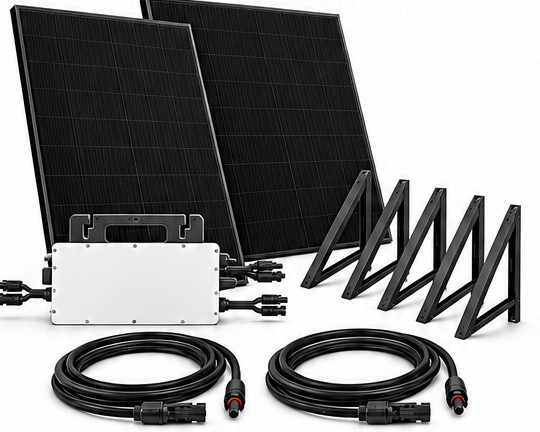
A plug-in kit is one or two solar panels, a mounting kit and a small microinverter, supplied together. The panels go on a wall, balcony, shed or garden frame. The microinverter's lead plugs into an ordinary wall socket, and whatever the panels generate is used by whatever's running in your home at the time.
Until this summer, connecting a generator to a normal socket wasn't allowed in the UK. The government changed the plugs-and-sockets safety regulations (SI 2026/848, made on 16 July 2026) so that certified plug-in solar can be sold and self-installed from 27 August 2026. It applies in England, Wales and Scotland, not Northern Ireland. The key word is certified: the complete kit has to be listed as compliant on the Energy Networks Association (ENA) register.
The exact kit (panels, inverter, plug and mounting) has to appear as Compliant on the ENA register. Mixing your own parts doesn’t count.
The microinverter is limited to 800W output, and only one plug-in device is allowed per household at the moment.
The kit must connect using its own factory-fitted UK plug. No extension leads, multi-way adaptors or plug converters.
The socket should be on an RCD-protected circuit. Some older fuse boxes and older types of RCD aren’t suitable, so if you’re unsure, get an electrician to check first.
Notify your network operator within 28 days of connecting (full steps below), tell your home insurer, and get your landlord’s permission if you rent.
Batteries sit outside the plug-in rules, and plug-in kits don’t qualify for Smart Export Guarantee payments. The saving is the power you use as it’s made.
Appearing on the register isn't the same as being compliant: some entries are still under review or have been marked non-compliant. Before you pay for any kit:
Plug-in solar runs on a “connect and notify” rule, part of the G98 connection standard. You don't need permission first and it's free, but you do have to tell your local network operator that a generator is now connected. That's the company that runs the cables in your area, not your electricity supplier.
| Starts with | Network operator | Covers | Where to notify |
|---|---|---|---|
| 23 | Northern Powergrid | Yorkshire and northern Lincolnshire, most of our area | northernpowergrid.com |
| 11 | National Grid Electricity Distribution (formerly Western Power Distribution) | East Midlands, including Lincoln | National Grid micro-generation (G98) page |
Each operator runs its own process and the plug-in route is new, so your kit’s instructions and your operator’s website have the final word.
Here are our estimates for the two kits we plan to sell. They're deliberately cautious.
| Kit | Estimated generation | Worth up to |
|---|---|---|
| 465W (one panel) | around 440 kWh a year | roughly £120 a year |
| 930W (two panels) | around 880 kWh a year | roughly £240 a year |
Estimates only. They assume an unshaded, south-facing panel at a good angle, around 950 kWh per kWp per year and 27p per kWh, with every unit used at home as it's generated. A wall or balcony mount, shade, or an east- or west-facing position will give less. A small kit suits daytime use: the fridge-freezer, the router, standby loads, someone working from home.
Anywhere that gets decent light and where the panel can be fixed securely: a south, east or west wall, a balcony rail, a garden frame, a shed or garage roof, a flat roof. Two sensible warnings: don't mount a panel on flammable cladding or a timber balcony, and fix it properly. A panel is large and catches the wind. If you rent, or live in a flat, check with your landlord or freeholder first.
| Plug-in kit | Roof system with battery | |
|---|---|---|
| Size | Up to 800W output | Several kW, sized to your roof |
| Installation | Self-install, no roof work | Professional install |
| Battery | Not allowed under the plug-in rules | Yes |
| Export payments | None | Possible (eligibility rules apply) |
| Typical outlay | Hundreds of pounds | Thousands of pounds |
They aren't rivals. A plug-in kit is a low-cost way to start, and a roof system is the bigger step if you want to cover much more of your bills or add storage. If you're not sure which suits your home, ask us. We'll tell you honestly, even if the answer is the cheaper one.
Our 465W kit is £499 and our 930W kit is £849. Both are going through ENA listing now, expected within about two weeks. Join the waitlist and we'll email you the moment they're listed and ready to order.
Join the waitlistThis guide is general information, last checked in October 2026. The rules are new and official guidance is still being updated, so check the latest before you connect anything, and ask a qualified electrician if you're unsure about your wiring.